Wednesday5 lessons · about 10 min
Temperature Control Wednesday
बुधवार का Temperature Control
Master the danger zone, hot holding, cold chain and buffet rules. Five lessons that protect every guest.
Danger zone से lekar buffet rules tak — पाँच lessons जो guests को safe रखते हैं।
Play in order
Start sprint →- 1
 EP 09 · 1:54
The 5°–60° Danger Zone Rule Every Chef Must Know
Between 5°C and 60°C bacteria double every 20 minutes. One tray of chicken left at 22°C for two hours is not late — it is contaminated. Senior chef Priya (channel debut) catches junior commis Aisha's mistake and teaches the temperature rule that separates safe kitchens from FSSAI-shutdown ones. This is the CCP that HACCP is built around. Play it before every service. Lock it before you touch a raw protein again.
- 2
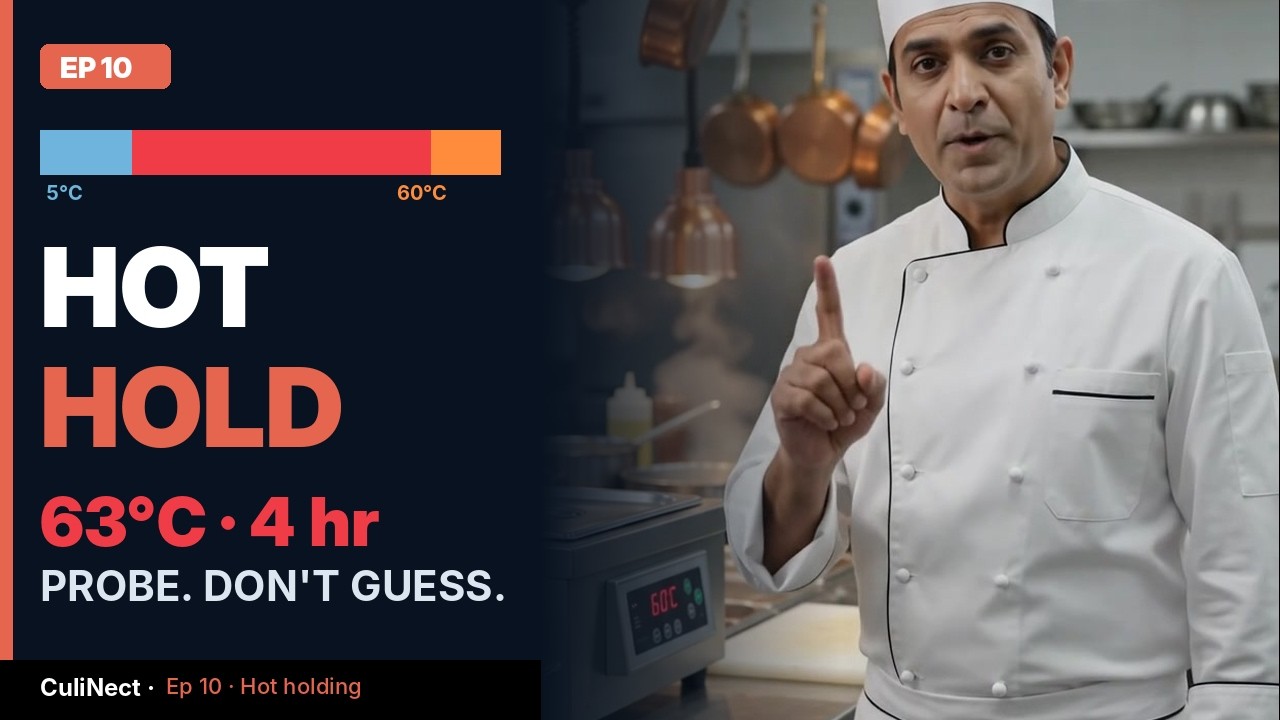 EP 10 · 1:54
Hot Hold ≥63°C, 4 Hours Max — The Buffet Rule Nobody Follows
Your bain-marie is bubbling. That means nothing. Probe the dal at the centre — what temperature is that? THAT number is what matters. Not the water. Not the pan. The food. Chef Priya teaches the hot-holding rule that separates buffets that pass FSSAI audits from ones that get shut down: internal ≥63°C, 4-hour cumulative maximum, probe every 2 hours, one-time reheat to 74°C, then discard. And the 2/4 cooling rule that stops Clostridium perfringens from growing overnight in your walk-in.
- 3
 EP 03 · 1:49
What Goes Where in the Fridge — Top-to-Bottom Shelf Rules
The shelf you put your chicken on can put a guest in hospital. Top-to-bottom hierarchy is not decoration — it's drip physics.
- 4
 EP 11 · 2:10
The Walk-in Discipline: ≤5°C, Top-to-Bottom, FIFO
Your walk-in isn't storage. It's a hierarchy — and a clock. Chef Priya walks you through the discipline that runs every professional kitchen: the ≤5°C hold, the top-to-bottom shelf order that stops cross-contamination, the three labels every container must carry, FIFO (First In First Out), the strip curtain rule, and the mistakes that quietly spoil a kitchen's cold chain. Play this before service. Your bottom shelf is where raw chicken belongs — not on top of the cooked curry. And that container without a date? Bin it.
- 5
 EP 08 · 1:49
3 Labels Every Container Needs — Item, Date, Initials
One sticker with one word isn't a label — it's trash. Three fields on every container: what, when (prep + use-by), who. That's FIFO's foundation.
Run this sprint at the start of every shift on Wednesday.